This is the highest evolution of the Multi-Array Queues (after the Java Queues and the Lock-Free Queue): A Queue that is linearizable, lock-free, and in the steady state (i.e. no Queue extensions (anymore)) also wait-free and garbage-free.
The garbage-freedom in the steady state makes this Queue wait-free unconditionally, as no memory allocator (that would disturb the wait-freedom) is involved in there.
This work has been inspired by the Kogan & Petrank Queue in the sense than the linearization operations themselves can be helped by other threads if the helpee has a phase number lower than (or equal to) the phase number of the helper. Other actions (that do not constitute linearization points) can be helped by other threads too. Metaphorically, the algorithms can be seen as a "big carousel" of linearization helping and helping to finish already linearized operations.
To illustrate the principle by an extreme (but possible) execution path: A thread begins its operation by drawing a new phase number and registering the operation in the state array. Immediately after that it goes asleep. In the meantime other threads help linearize and finish the registered operations. When the bespoke thread wakes up, it "goes round" the state array and finds that all operations with phase numbers up to (and including) its phase number are already done, some eventually already replaced by new operations (with higher phase numbers). So without having done any "real work", the thread can successfully return.
The bound on the number of execution steps depends on the number of active threads (this is inherited from the Kogan & Petrank Queue). The program codes of this Wait-Free Queue are more complex than those of the Lock-Free Queue, and there are also more CASes on the path, so that a lower throughput is expected - even in the uncontended case.
In short: There are currently two implementations aligned with each other: a Spin model and the JavaScript Simulator. No real (i.e. non-model) implementation exists (yet).
In long: The algorithms have first been designed and verified as a model for the Spin model checker (for computer-aided simulations and exhaustive verifications). The Spin model file is the primary source of information and comments on the algorithms as such.
After that the JavaScript Simulator has been developed (for teaching and visual/manual simulations and verifications).
For a future "real" implementation similar choices exist as for the Lock-Free Queue, with x86-64 assembly combined with C++ being presumably the most attractive option.
The Wait-Free Multi-Array Queue is a linearizable multiple-writer multiple-reader lock-free FIFO Queue that is in the steady state (i.e. no Queue extensions (anymore)) also wait-free and garbage-free.
The extension operations, however, involve the memory allocator which (most-probably) is not wait-free. Further, more than one thread can consider extending the Queue. Each of these competing threads then prepares (allocates) memory for the new ring and tries to CAS it into the rings array. The memory of the winning thread goes into use, but the losing threads have to free the allocated memory again. In other words: A strict garbage-freedom has to be sacrificed in this case (in the sense that superfluous calloc-free pairs may occur).
The Wait-Free Queue builds on top of the Lock-Free Queue with this main difference:
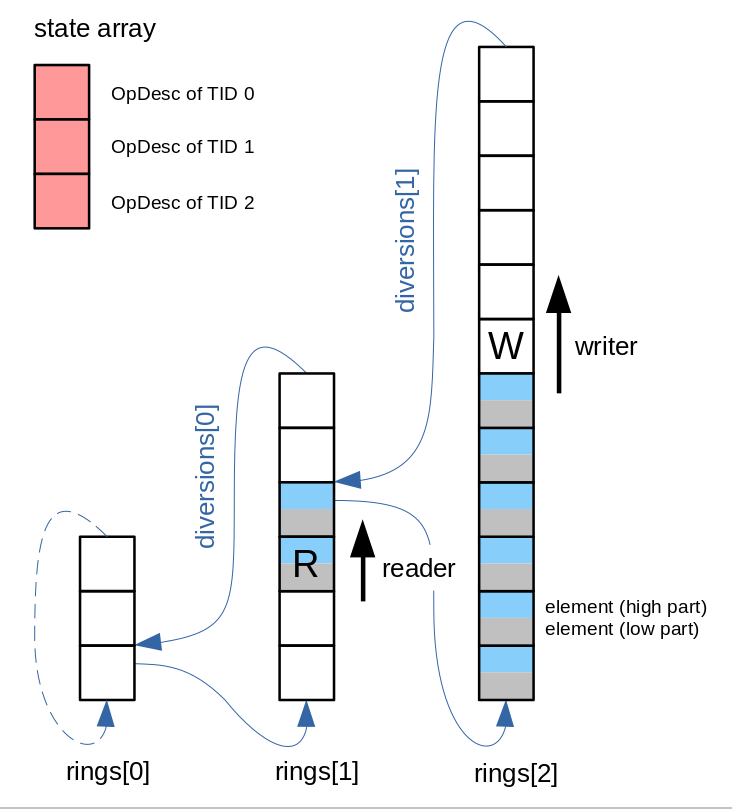
One array element consists of two halves, each 128-bit wide.
The "high half" carries the payload and metadata as in the Lock-Free Queue.
The "low half" carries the Thread-ID (index into the state array) and the phase number of the operation that operates on that array element. This information is necessary for the finishing steps that can be helped by different threads (in an extreme case the linearization and each helping step can be done by a different thread).
It is actually the successful 128-bit CAS (CMPXCHG16B) into the "low half" that is the linearization operation.
The finishing steps for Enqueue are (each being a CAS as well):
- transfer of the payload from the state array into the "high half" of the array element
- switch off the pending flag in the state array
- move the writer position forward
The finishing steps for Dequeue are (each being a CAS too):
- transfer of the payload from the "high half" of the array element into the state array (together with switching off the pending flag there)
- move the reader position forward
From the above follows that the Wait-Free Queue has double memory consumption compared with the Lock-Free Queue, which means quadruple memory consumption compared with the original Java Queues.
- Currently (2026), this code is only for academic interest, not for production use.
- Reviews, tests and comments are welcome.
- Should you have found a concurrency counterexample, please attach to your ticket your Spin input + trail file or the trail from the JavaScript Simulator that leads to the issue. As with other similar algorithms, an eventual counterexample could be either fixable or unfixable (in which case the whole algorithm would have to be discarded).
- Do not send me Pull Requests - the code is small, so I want to maintain it single-handedly.
MIT License